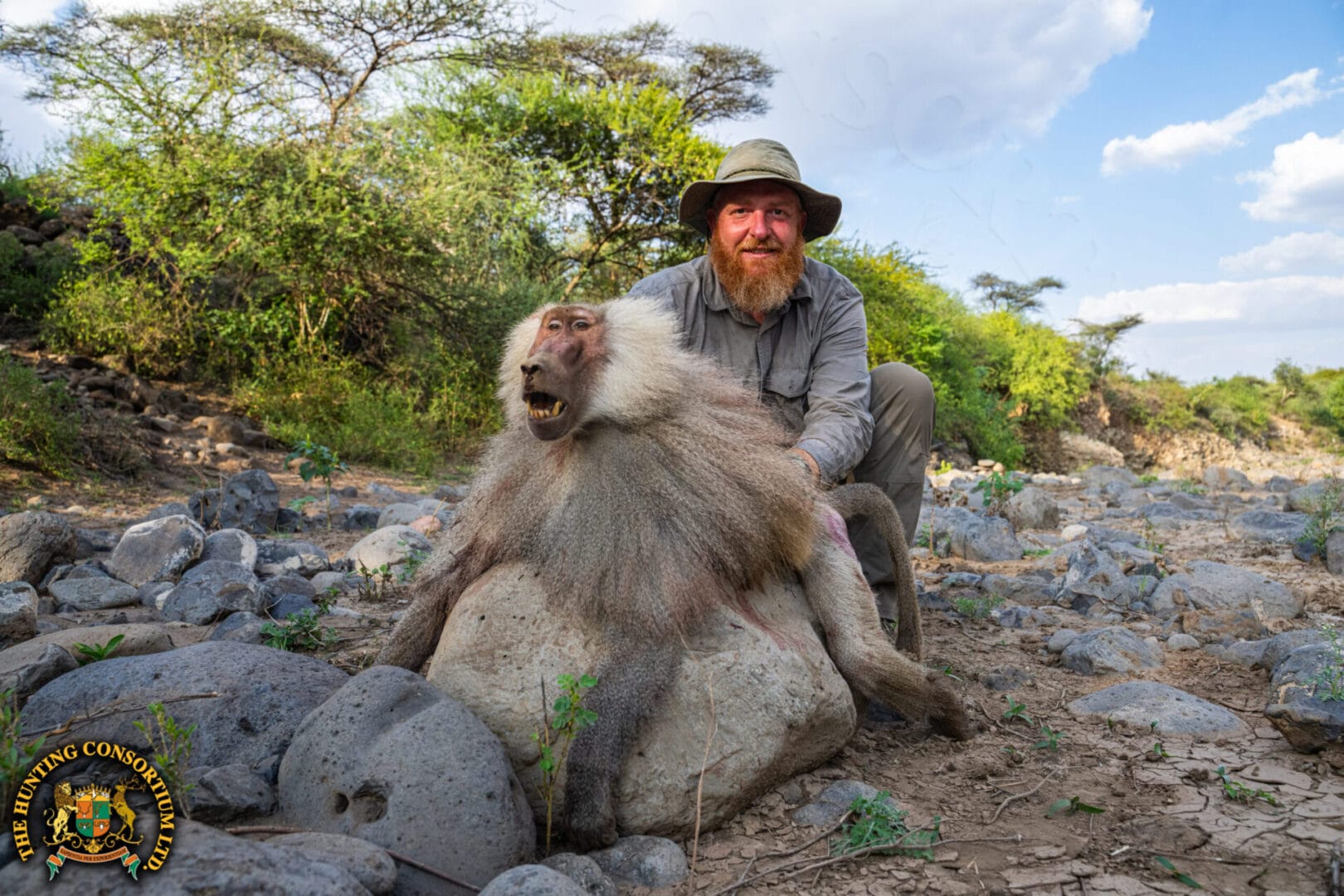
Baboon hunting in Africa presents an unusual challenge for serious sportsmen. Few animals encountered on an African safari combine the intelligence, physical strength, social awareness, and remarkable adaptability of the baboon. These formidable primates inhabit environments ranging from rocky mountain escarpments and open savannas to riverine woodland and rugged bushveld, where their cautious behavior makes them difficult to approach.
Unlike many conventional plains game animals, baboons live in highly organized social groups, communicate through an extensive range of vocalizations and gestures, and demonstrate an exceptional ability to recognize disturbances in their surroundings. Their keen eyesight, alert disposition, and constant interaction with other troop members make baboon hunting a specialized pursuit requiring patience, sound judgment, and experienced professional guidance.
For international hunters, baboon hunting is often considered as a secondary objective during a broader African safari. However, experienced sportsmen recognize that successfully pursuing a mature male baboon under appropriate legal and ethical conditions can require considerable fieldcraft.
The Hunting Consortium has helped clients arrange international hunting expeditions since 1985. Our approach to baboon hunting emphasizes responsible destination selection, accurate species identification, experienced professional relationships, and the logistical planning necessary to execute a well-organized African safari.
Whether evaluating Chacma Baboon hunting in southern Africa or Olive Baboon hunting in East Africa, the objective remains the same: identify an appropriate opportunity, understand the conditions of the selected hunting territory, and pursue the experience with discipline and respect for wildlife.
Baboons are large, terrestrial monkeys belonging to the genus Papio. They are among Africa’s most recognizable primates, distinguished by their elongated, dog-like muzzles, powerful jaws, prominent canine teeth, and strong, muscular bodies.
Most modern classifications recognize five principal baboon species: Olive Baboon, Yellow Baboon, Chacma Baboon, Hamadryas Baboon, and Guinea Baboon.
These species differ in geographic distribution, appearance, body size, and certain aspects of social organization.
For baboon hunting, accurate identification is important because an animal’s natural distribution does not necessarily correspond with its legal availability as a hunting species.
Additional information about baboon taxonomy, natural history, and geographic distribution is available through the general baboon species reference and the African Wildlife Foundation’s baboon profile.
The animals commonly discussed in connection with baboon hunting belong to several geographically distinct species. However, not every species is legally available for recreational or trophy hunting, and specific permissions vary considerably by country and hunting territory.
The Chacma Baboon (Papio ursinus) is one of the largest baboon species and is particularly associated with southern Africa.
It inhabits mountainous country, rocky hills, open woodland, savannas, and certain relatively arid environments.
Mature males possess substantial bodies, powerful shoulders, and prominent canine teeth. Their physical development and distinctive appearance make them recognizable among the region’s larger primates.
Chacma Baboon hunting has historically formed part of safari opportunities in South Africa, subject to applicable provincial regulations and landowner permissions.
The South African National Biodiversity Institute provides additional information about this species in its Chacma Baboon species profile.
The Olive Baboon (Papio anubis) is among the most widely distributed baboons in Africa.
It occupies suitable habitats across portions of western, central, and eastern Africa, including savannas, woodlands, grasslands, and some forest margins.
The species is recognized by its olive-gray coloration, substantial body, and characteristic dark face.
Mature males develop an impressive mane around the head, neck, and shoulders, contributing to their powerful appearance.
Olive Baboon hunting may be relevant to certain authorized African safari programs, particularly where the species appears on the applicable government hunting schedule.
The Olive Baboon is also known as the Anubis Baboon. These are two names for the same species, not separate animals.
The Yellow Baboon (Papio cynocephalus) inhabits portions of eastern and southeastern Africa.
It is generally lighter in coloration than the Olive Baboon, with a relatively slender appearance and a yellowish or golden-brown coat.
Yellow Baboons occupy savanna, woodland, and other suitable habitats where food resources and protective sleeping areas are available.
Like other baboons, they live in complex social groups and rely on constant vigilance to identify potential threats.
Yellow Baboon hunting should only be considered where the species is specifically included within the applicable hunting regulations and authorized quota.
The Hamadryas Baboon (Papio hamadryas) is associated primarily with the Horn of Africa and parts of the Arabian Peninsula.
Mature males possess a particularly distinctive appearance, with a pale or silvery mantle of hair surrounding the head and shoulders.
The species inhabits rocky hills, escarpments, and relatively dry landscapes.
Its social organization differs from that of many other baboons and includes characteristic one-male social units within larger groups.
Although the Hamadryas Baboon is of interest to wildlife observers and primate researchers, its presence within a country should not be interpreted as evidence that a commercial baboon hunting opportunity is available.
Any proposed hunting activity would require explicit confirmation from the relevant wildlife authority.
The Guinea Baboon (Papio papio) occupies parts of western Africa.
Its appearance is distinguished by a reddish-brown coat and the relatively compact proportions characteristic of this regional species.
Guinea Baboons inhabit suitable savanna and woodland environments, although their distribution is more restricted than that of Olive Baboons.
They also exhibit distinctive social relationships that have attracted considerable scientific interest.
Guinea Baboon hunting should not be advertised as routinely available without current species-specific legal authorization and an assessment of local conservation conditions.
The Gelada (Theropithecus gelada) is frequently called the Gelada Baboon, but it is not a true baboon belonging to the genus Papio.
This remarkable Ethiopian primate occupies high-altitude grasslands and rocky escarpments and is distinguished by its conspicuous red chest patch.
Geladas are primarily grass-eating primates and possess a distinctive ecological specialization.
Ethiopia’s wildlife authority identifies the Gelada as a protected endemic primate.
For this reason, the species should not be included as a standard baboon hunting offering without explicit confirmation of any exceptional legal authorization.
Additional information is available from the African Wildlife Foundation’s Gelada profile.
Baboon hunting differs substantially from conventional African plains game hunting because of the animal’s intelligence, group behavior, and familiarity with its surroundings.
Baboons are highly adaptable primates capable of occupying diverse habitats and responding quickly to potential threats.
Within a troop, individual animals constantly observe their surroundings while feeding, resting, and moving.
The alarm response of one individual may rapidly alert the remaining group.
One of the defining characteristics of baboon hunting is the need to account for the animal’s complex social behavior.
Baboons live in troops that may contain numerous adult males, females, juveniles, and dependent young.
These groups maintain social hierarchies, establish relationships, and communicate through calls, facial expressions, and physical gestures.
Their ability to recognize unfamiliar activity can make them particularly cautious in areas experiencing regular human disturbance.
For experienced sportsmen, baboon hunting demands careful observation and an understanding of how the entire troop responds to potential danger.
Baboons are visually oriented animals with an excellent ability to detect movement.
They often occupy elevated positions or open terrain that allows them to observe their surroundings.
In rocky or mountainous environments, a troop may detect approaching activity from considerable distances.
This alert disposition makes baboon hunting especially demanding in open country where natural concealment is limited.
Mature male baboons possess substantial muscular development and powerful canine teeth.
Although baboons are predominantly terrestrial, they are capable climbers and can move quickly across rocky ground, woodland, and uneven terrain.
Their physical strength and defensive capabilities require appropriate caution and professional field judgment.
Respect for the animal’s capabilities is an essential part of responsible baboon hunting.
Baboon hunting opportunities depend on the species, the country, the selected hunting territory, and current legal authorization.
Although baboons occur across a substantial portion of Africa, hunting regulations differ considerably between countries and, in some cases, between provinces or wildlife-management areas.
South Africa is one of the principal countries historically associated with Chacma Baboon hunting.
The species occupies a variety of environments, including rocky mountains, bushveld, woodland, and open grassland.
These contrasting habitats produce different hunting conditions, ranging from relatively open terrain to steep and heavily vegetated hillsides.
South African baboon hunting is governed by provincial wildlife regulations, and legal requirements can vary by location and the status of the hunter or landowner.
The Hunting Consortium emphasizes confirming the applicable provincial rules, hunting permissions, and professional arrangements before planning an expedition.
Tanzania supports several baboon populations, including Olive and Yellow Baboons in suitable regions.
The country’s varied landscapes include open savanna, riverine woodland, rocky hills, and extensive wildlife habitats.
Baboon hunting in Tanzania may be considered in connection with an authorized safari where the species is included on the relevant hunting permit.
The Tanzania Wildlife Management Authority regulates tourist hunting through designated hunting blocks, government permits, and established quotas.
Hunters can review the general framework through the Tanzania Wildlife Management Authority’s hunting tourism guidance.
Because official hunting schedules and species classifications can change, current authorization must be verified before including a baboon in a safari program.
Ethiopia supports several remarkable primate species, including Olive Baboons, Hamadryas Baboons, and Geladas.
Its landscapes range from dry lowlands and rocky escarpments to high-altitude grasslands.
However, species occurrence must be distinguished from hunting eligibility.
The Gelada is a protected endemic primate, and the legal status of any proposed baboon hunting opportunity must be established with the Ethiopian wildlife authorities.
For serious sportsmen, Ethiopia should not be presented as a general-purpose baboon hunting destination without verification of the species, hunting territory, and current permit conditions.
Uganda supports Olive Baboon populations in suitable savanna, woodland, and forest-edge habitats.
The species is particularly adaptable and may occur near grassland, riverine vegetation, and woodland environments.
However, Uganda regulates wildlife utilization through a formal system of wildlife-use rights and professional licensing.
Baboon hunting in Uganda cannot be presumed legal simply because Olive Baboons are present within the country.
Current wildlife-use authorization, species eligibility, and the applicable hunting area must be confirmed independently.
Where legally authorized, baboon hunting generally relies on careful observation, traditional stalking, and the experience of professional hunters familiar with the selected hunting territory.
The appropriate method depends on habitat, species, terrain, and applicable legal restrictions.
Spot-and-stalk hunting is commonly associated with African safari pursuits in open country and woodland environments.
For baboon hunting, the animal’s excellent eyesight and troop vigilance can make an approach particularly demanding.
Professional hunters must evaluate the surrounding terrain, the behavior of the animals, and the conditions of the selected hunting area.
Patience and disciplined field judgment are essential, particularly where baboons occupy elevated ground or open savanna.
Observation is an important component of baboon hunting because the animals commonly travel and rest in social groups.
Experienced professional hunters may assess a troop’s composition and behavior before determining whether an appropriate opportunity exists.
Mature males often exhibit substantial physical development, including larger bodies, pronounced canine teeth, and distinctive facial characteristics.
However, individual differences and social behavior must be considered carefully.
Responsible baboon hunting requires positive identification and sound judgment.
Tracking may provide useful information about recent baboon movements through woodland, rocky terrain, and other suitable habitats.
Experienced trackers interpret signs of feeding, movement, and the use of established resting or sleeping areas.
However, baboons are highly mobile animals whose movements can vary according to food availability, disturbance, and local conditions.
For baboon hunting, the experience of professional guides familiar with the selected territory is especially important.
Some historical accounts describe the use of bait or other attraction methods in baboon hunting.
However, the legality of such techniques varies by country, province, and hunting territory.
No method should be assumed acceptable simply because it has been used elsewhere.
The Hunting Consortium emphasizes compliance with current regulations and the professional standards applicable to the selected operation.
The appropriate season for baboon hunting depends on the destination, current hunting regulations, and local environmental conditions.
Unlike certain African antelope whose movements are strongly influenced by seasonal grazing, baboons are highly adaptable omnivores capable of exploiting a wide range of food sources.
Consequently, their daily activity and geographic movements cannot be reduced to one universal hunting season.
In some African destinations, relatively dry conditions may provide improved road access and visibility.
Changes in vegetation can influence how easily baboons are observed within woodland and savanna habitats.
However, access and environmental conditions vary substantially between regions.
For baboon hunting, the legal hunting season and the recommendations of the professional operator should determine the appropriate timing.
Seasonal rainfall can increase vegetation growth and affect road access in certain hunting areas.
Baboons may continue to exploit a wide range of food resources during these periods.
Their use of woodland, grassland, and rocky terrain may change according to local conditions.
Any proposed baboon hunting dates should therefore reflect the selected territory rather than a generalized schedule for the African continent.
Baboon hunting is often considered as a secondary objective during a broader African safari.
Depending on the country, hunting area, and permitted species, baboons may share suitable habitat with warthog, impala, kudu, bushbuck, and other regional game animals.
For experienced international sportsmen, combining objectives can provide a broader appreciation of the wildlife and landscapes associated with the selected destination.
However, the presence of multiple species within a country does not establish that they are all available within one hunting concession.
Each species may be subject to separate regulations, permits, quotas, and professional requirements.
The Hunting Consortium helps clients evaluate appropriate species combinations while maintaining a clear focus on the principal objectives of the safari.
Preparation for baboon hunting begins with understanding the selected destination and the practical conditions of the hunting territory.
Physical demands vary considerably, depending on whether the animals occupy open savanna, rocky mountains, dense woodland, or more broken country.
Some baboon hunting areas may involve walking across uneven terrain or moving through rocky and mountainous environments.
Other locations offer relatively open woodland or grassland conditions.
Appropriate physical conditioning and realistic expectations are important components of preparation.
The Hunting Consortium helps clients evaluate hunting opportunities suited to their experience, interests, and capabilities.
Dependable footwear, comfortable field clothing, sun protection, and reliable optics should be considered during preparation.
Binoculars may assist with observing animals across open terrain and evaluating troop composition.
Firearm and ammunition arrangements must comply with the laws of the selected destination and the recommendations of the professional hunter.
For baboon hunting, appropriate equipment and disciplined field conduct remain essential.
International baboon hunting may require coordination of flights, domestic transportation, accommodations, hunting permits, professional guides, firearm documentation, and trophy export procedures.
The requirements vary according to the species and destination.
Experienced planning is particularly important when baboon hunting forms part of a broader multi-species African safari.
The Hunting Consortium helps clients evaluate these arrangements and coordinate the practical details with established local professionals.
One important consideration in international baboon hunting is the legal treatment of primate trophies.
Baboons are nonhuman primates, and their skins, skulls, and other trophy materials may be subject to additional import restrictions.
For hunters returning to the United States, the Centers for Disease Control and Prevention regulates certain nonhuman-primate trophy materials because of infectious disease risks.
Depending on processing and documentation, an import may require a CDC permit or acceptable evidence that the trophy has been rendered noninfectious.
Other requirements may include wildlife declarations, applicable CITES documentation, and inspection by the appropriate authorities.
For baboon hunting clients, these requirements should be understood before the safari rather than addressed only after a trophy has been taken.
The Centers for Disease Control and Prevention’s animal-product import guidance provides additional information about restricted species and trophy materials.
Responsible baboon hunting must account for local wildlife regulations, species conservation status, population conditions, and the broader ecological role of these primates.
Baboons are intelligent, adaptable animals that influence their environments through feeding, seed dispersal, and interactions with other wildlife.
However, populations and conservation circumstances vary among species and geographic regions.
In some African regions, baboons come into conflict with agricultural communities because of crop damage or other interactions with people.
However, the presence of human-wildlife conflict does not automatically justify recreational hunting or establish that a particular population can support additional harvest.
Responsible management should consider local population information, the nature of the conflict, and the available regulatory framework.
Where hunting is legally authorized, it must remain consistent with the management objectives established for the area.
Ethical baboon hunting requires positive species identification, compliance with applicable regulations, appropriate equipment, and sound professional judgment.
The selection of individual animals should reflect the requirements of the authorized hunting program.
Hunters should avoid creating unnecessary disturbance to dependent young and other members of a troop.
As with all African hunting, responsible conduct requires respect for the animal and the surrounding environment.
Regulated hunting can support wildlife management and local employment where appropriate systems are established.
However, conservation benefits should be supported by documented programs rather than assumed for every baboon hunting operation.
Permit fees, professional employment, and other economic activities may contribute to local economies, but the extent of conservation funding depends on the destination and the management arrangements in place.
The Hunting Consortium recognizes that credible conservation commitments require transparency, legal compliance, and a long-term understanding of the wildlife resource.
The Hunting Consortium has been helping serious sportsmen pursue international hunting opportunities since 1985.
Our experience extends across a broad range of African destinations, species, and demanding safari environments.
For baboon hunting, this expertise is reflected in our emphasis on accurate species identification, appropriate destination selection, experienced professional relationships, and careful logistical planning.
We understand that the practical requirements of a Chacma Baboon hunt in southern Africa may differ considerably from those associated with an Olive Baboon opportunity in East Africa.
We also recognize that not every species occurring within a destination is legally available for hunting.
Our role is to help clients distinguish between suitable, authorized opportunities and arrangements that require additional verification.
This disciplined approach reflects The Hunting Consortium’s commitment to informed judgment and trusted guidance in international hunting.
Baboon hunting remains a distinctive pursuit for experienced international sportsmen interested in the intelligence, adaptability, and formidable physical characteristics of Africa’s larger primates.
From the rocky hills and bushveld of southern Africa to the wooded savannas of East Africa, baboons occupy varied environments that demand careful observation and experienced fieldcraft.
For hunters considering baboon hunting as part of a broader African safari, appropriate species identification, legal authorization, and professional planning are essential.
The Hunting Consortium provides trusted guidance in evaluating baboon hunting opportunities, understanding destination-specific requirements, and coordinating the practical arrangements necessary for a responsibly planned African safari.
Contact The Hunting Consortium to discuss baboon hunting in Africa, suitable destinations, species classifications, current legal opportunities, and the professional guidance necessary to plan your next international hunting expedition.
"*" indicates required fields