2005: R. v. Martin and the B.C. Court of Appeal
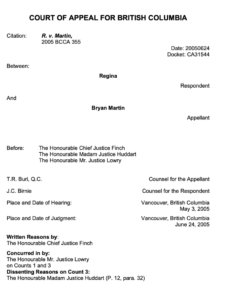
Regarding Asian Mountain Outfitters, the most detailed legal record is R. v. Martin, 2005 BCCA 355, a decision of the Court of Appeal for British Columbia. The case lists Regina as respondent and Bryan Martin as appellant, under docket CA31544, with judgment issued June 24, 2005. The appeal concerned two convictions under British Columbia’s Wildlife Act. The court identified the issues as the interpretation of the statutory definitions of “guide” and “resident.”
The Guiding-Licence Issue With Bryan Martin (of Asian Mountain Outfitters)
Count 1 alleged that Martin, between August 25 and September 1, 1999, at or near Fort Ware, British Columbia, “did unlawfully guide for game without being the holder of a guide outfitter licence.” The Court of Appeal stated that it was admitted Martin did not hold a guide outfitter’s licence at the relevant time; the question was whether he was acting as a guide.
The facts summarized by the court involved a hunter who had contracted with Canadian Mountain Outfitters for a guided hunting trip. A licensed guide became unavailable because of illness and weather conditions. The court’s summary states that Martin supplied a rifle, accompanied the hunter, stalked a mountain goat with him, and provided advice about candidate goats. The lower court had found that Martin assisted the hunter and performed services that fulfilled the company’s obligation to provide guiding services.
The Court of Appeal upheld the reasoning that the compensation did not have to be paid directly to Martin for his personal services. What mattered was the relationship between the compensation received and the guiding services provided. The court concluded that the Crown had established a purposive connection between the compensation and the assistance Martin provided, and that Martin had not established a due diligence defence. The appeal on Count 1 was dismissed.
The Hunting-Licence Residency Issue
Count 3 involved a separate conviction for hunting without holding a hunting licence issued to him. Martin had applied for a 2001 hunting licence and certified that he was a resident of British Columbia. The case turned on whether he met the statutory residency requirement.
The majority concluded that the phrase “has resided” was to be evaluated objectively on the basis of physical presence, and that Martin had not met the requirement of residing in British Columbia for seven of the previous twelve months. The majority dismissed the appeal on that count as well.
Why the 2005 Decision Matters to Asian Mountain Outfitters Research
The decision should not be oversimplified. Justice Huddart agreed with the Chief Justice’s reasoning on Count 1, but dissented on Count 3. Her dissent emphasized the ambiguity of residency language and would have allowed the appeal from the conviction for unlawful hunting, set aside that conviction, and restored the acquittal at trial on that count. The legal outcome remained that the appeal was dismissed, but the dissent is important context for the residency issue.
For prospective clients, the 2005 decision is relevant because it deals directly with licensing, guide status, and the legal consequences of continuing a hunt when the expected licensed guide was not available. It does not establish anything about current licensing or current operations. Its significance is historical, but the subject matter is directly connected to the trust structure of guided hunting.
2008: B.C. Ministry of Environment Wildlife Act Bulletin
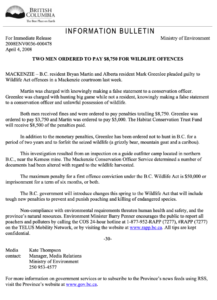
A second source is a B.C. Ministry of Environment information bulletin dated April 4, 2008, release ID 2008ENV0036-000478, titled “Two Men Ordered to Pay $8,750 for Wildlife Offences.” The bulletin states that B.C. resident Bryan Martin and Alberta resident Mark Greenlee pleaded guilty to Wildlife Act offences in a Mackenzie courtroom.
Charges and Penalties by Bryan Martin of Asian Mountain Outfitters Reported by the Ministry
The bulletin identifies the charges separately. It states that Martin was charged with knowingly making a false statement to a conservation officer. It states that Greenlee was charged with hunting big game while not a resident, knowingly making a false statement to a conservation officer, and unlawful possession of wildlife. That separation matters. The Greenlee charges should not be attributed to Martin.
The Ministry bulletin states that both men received fines and were ordered to pay penalties totaling $8,750. It reports that Greenlee was ordered to pay $3,750 and Martin was ordered to pay $5,000, with $8,500 of the penalties going to the Habitat Conservation Trust Fund. It also states that Greenlee was ordered not to hunt in British Columbia for two years and to forfeit seized wildlife.
Guide Outfitter Camp Inspection Near the Kemess Mine
The bulletin further states that the investigation resulted from an inspection of a guide outfitter camp in northern British Columbia, near the Kemess mine. According to the Ministry, the Mackenzie Conservation Officer Service determined that a number of documents had been altered with regard to the wildlife harvested. The bulletin does not state who altered those documents, and a careful reading should not imply an answer the source does not provide.
This record is significant because it is an official government statement concerning Wildlife Act offences and penalties. It is not, by itself, evidence of current conduct, current licensing status, or the present operating condition of any business associated with Martin.
2020 and 2022 Wild Sheep Foundation Advisory on Asian Mountain Outfitters
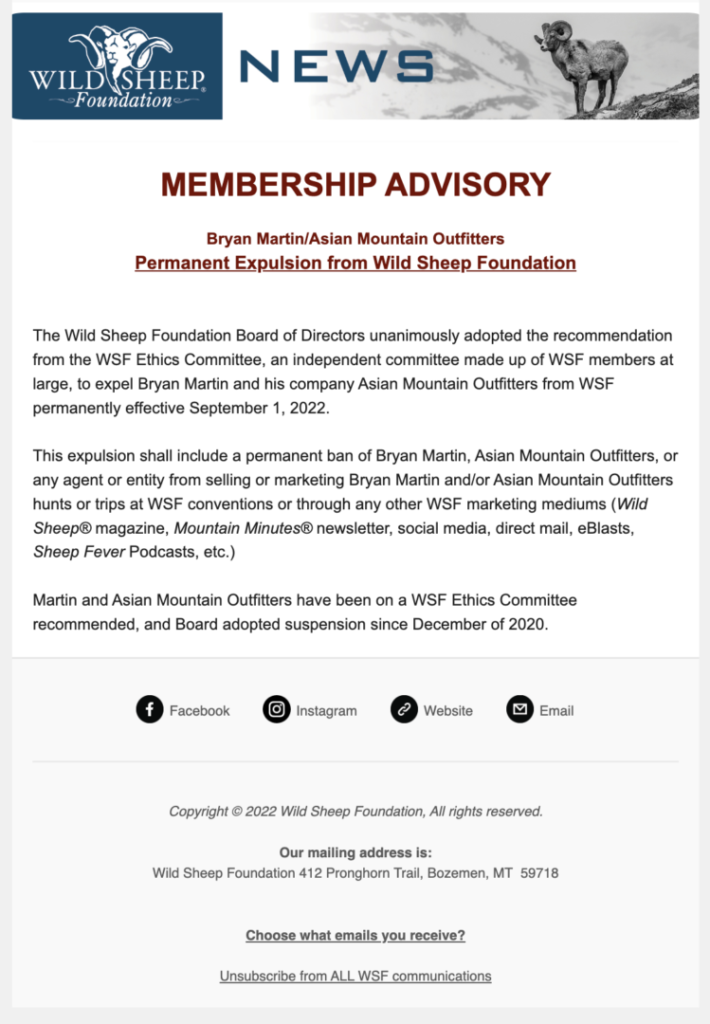
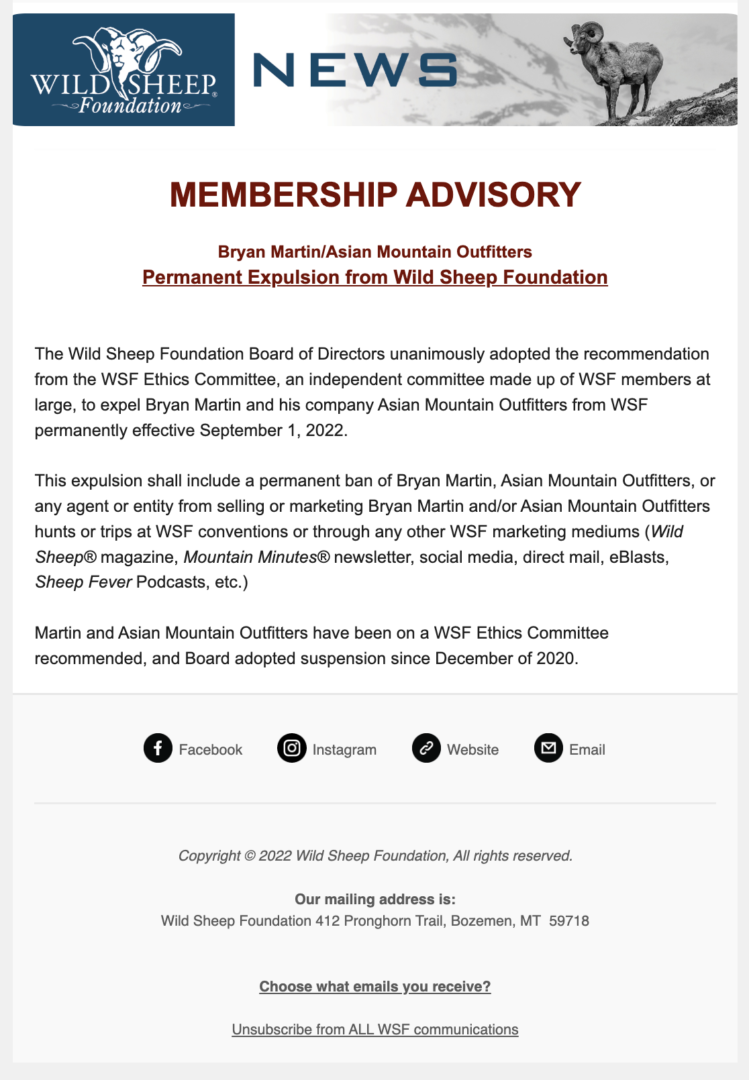
The Wild Sheep Foundation advisory is headed “Membership Advisory” and identifies “Bryan Martin/Asian Mountain Outfitters” and “Permanent Expulsion from Wild Sheep Foundation.” The advisory states that the Wild Sheep Foundation Board of Directors unanimously adopted a recommendation from the WSF Ethics Committee to expel Bryan Martin and Asian Mountain Outfitters from WSF permanently, effective September 1, 2022.
Scope of the WSF Expulsion and Ban
The advisory also states that the expulsion includes a permanent ban of Bryan Martin, Asian Mountain Outfitters, or any agent or entity from selling or marketing Bryan Martin and/or Asian Mountain Outfitters hunts or trips at WSF conventions or through WSF marketing mediums, including WSF publications, newsletters, social media, direct mail, email communications, and podcasts.
The advisory further states that Martin and Asian Mountain Outfitters had been on a WSF Ethics Committee recommended and Board adopted suspension since December 2020.
What the WSF Advisory Does and Does Not Establish
The WSF advisory is relevant to organizational standing in the hunting industry. It is also limited. The advisory does not state the basis for the expulsion. For that reason, the WSF action should not be causally linked to the 2005 Court of Appeal decision, the 2008 Ministry bulletin, or any other matter unless an additional source expressly makes that connection.
Contract Litigation Involving Asian Mountain Outfitters: How to Read a Civil Docket
The article also references Sanson v. Martin et al, case number 4:2022-cv-00791, in the U.S. District Court for the Northern District of California. Where a docket is cited, the safe reading is limited to what the docket itself lists: the parties, filing date, court, judge, nature of suit, cause of action, visible docket entries, and procedural status.
A Civil Docket Is Not a Finding of Liability
A civil complaint should be treated as allegations unless later filings establish findings, judgment, settlement, dismissal, or another disposition. A docket does not equal a finding of liability. It records procedural history. Unless the court record shows an adjudicated outcome, no conclusion should be drawn about liability, fault, damages, or the merits of the claims.
For buyers, the existence of contract litigation may still be relevant to due diligence, particularly where the dispute concerns services, payment, performance, cancellation, or business obligations. But the relevance lies in prompting better questions, not in assuming facts that have not been established.
What the Asian Mountain Outfitters Record May Signal for Buyers
Taken together, the records do not prove any single current condition of Bryan Martin, Asian Mountain Outfitters, or any related business. They do create a documented history that prospective customers may reasonably examine as part of due diligence.
Buyer-Relevant Areas in the Record
The record touches several buyer-relevant areas. The 2005 appellate decision involved guide licensing and the legal meaning of acting as a guide under British Columbia’s Wildlife Act. The 2008 Ministry bulletin involved a guilty plea to a Wildlife Act offence and penalties arising from an investigation connected to a guide outfitter camp inspection. The WSF advisory involved organizational discipline by a major hunting-industry organization. A civil docket, if reviewed, should be understood as a procedural record rather than proof of liability.
Those records are not identical in legal weight. A court decision, a government bulletin, an organizational advisory, and a civil docket serve different functions. But each is more substantial than rumor or informal commentary. A careful buyer would treat them as prompts for verification, not as complete answers.
Why Asian Mountain Outfitters Due Diligence Matters in Guided Hunting
International hunting arrangements are unusually trust-dependent. The client may pay substantial sums before traveling, often months or years before the hunt occurs. He may rely on the provider to coordinate local partners, concessions, licenses, tags, firearm paperwork, trophy export documentation, lodging, charter flights, ground logistics, and field personnel. In some destinations, the buyer is also relying on an intermediary’s judgment about political conditions, border procedures, and the quality of operators on the ground.
That structure makes reputation and compliance history relevant. A provider’s past record does not automatically determine present reliability, but it can help frame the questions a buyer should ask before signing a contract or wiring funds.
In this context, the documented history involving Martin and Asian Mountain Outfitters is not a substitute for current verification. It is a reason to conduct it carefully.
Due Diligence Questions Before Contracting with Asian Mountain Outfitters
Prospective clients evaluating any international hunting or outfitting provider should ask for current, written answers to practical questions.
Licensing, Permits, and Contracting Party
What licenses, permits, local authorizations, and guide arrangements apply to the specific hunt being offered? Who is the contracting party? Is the contracting party the same entity that will be responsible for performance in the field? What refund, cancellation, substitution, and force majeure terms are in writing? What happens if a specific guide, concession, camp, permit, or tag becomes unavailable?
Funds, Disputes, and Written Representations
Clients should also ask whether funds are escrowed or otherwise protected, what dispute forum and governing law apply, and whether representations about guide qualifications, permits, firearm import procedures, trophy export requirements, and local partners are documented before payment.
Organizational Standing and Disclosures
The same approach applies to organizational standing. If an outfitter or consultant has been disciplined by an industry organization, the buyer should ask whether that matter has been disclosed, whether the provider disputes it, whether any corrective action occurred, and whether the discipline affects access to conventions, marketing channels, partners, or references.
Prior legal or disciplinary records do not answer those questions automatically. They make the questions more important.
Limits of the Public Record on Asian Mountain Outfitters
Several cautions are necessary.
Older records may not reflect present operations. The 2005 decision and 2008 bulletin concern historical events. The WSF advisory does not explain the basis for the expulsion. A docket does not equal a finding of liability unless it includes an adjudication, judgment, or other dispositive entry. A complaint contains allegations unless those allegations are admitted, proven, or otherwise resolved through the court record.
This article does not establish current licensing status, current WSF membership status, current legal status, or current business activity. Those points require current official confirmation.
The strongest conclusion supported by the record is not condemnation. It is that buyers evaluating Bryan Martin or Asian Mountain Outfitters should review the documented public and organizational record alongside current licenses, contracts, references, written disclosures, and provider-specific operating details.
In a field where trust, compliance, and execution matter, that kind of due diligence is not excessive. It is prudent.